Article Summary:
- Form 941 Schedule B reports daily payroll tax liability, not tax payments, and is essential for IRS compliance. :contentReference[oaicite:0]{index=0}
- It is required for semiweekly depositors and employers meeting specific IRS deposit thresholds.
- Accurate reporting of payroll dates, not deposit dates, is critical to avoid IRS penalties and notices.
- Common errors include mismatched totals, incorrect depositor classification, and misreported liabilities.
- Proper reconciliation with Form 941 ensures accuracy and prevents compliance issues.
- Maintaining organized payroll records and reviewing filings improves accuracy and reduces audit risk.
Payroll tax compliance requires precision, not guesswork. A single reporting error can lead to penalties, notices, or extended IRS correspondence. Form 941 Schedule B plays a critical role in preventing those issues.
This schedule does not report tax payments. It reports when payroll tax liability is created. That distinction is where most employers make mistakes.
If you are a semiweekly depositor, filing 941 Schedule B correctly is mandatory. The IRS uses it to verify deposit timing. Accuracy protects your business from unnecessary enforcement.
Need help ensuring accuracy? Get an expert review of your Form 941 Schedule B filings before filing to avoid IRS penalties and reporting errors.
What Is Form 941 Schedule B’
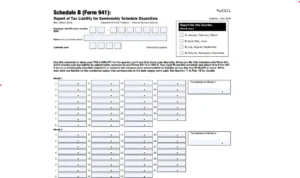
Form 941 Schedule B is an attachment filed alongside Form 941. It provides a daily breakdown of federal payroll tax liability for the quarter. This includes taxes created, not taxes paid.
Many employers assume liability and deposits are the same. They are not. Liability is tied to payroll dates, while deposits occur later.
The IRS relies on Schedule B form 941 to confirm compliance with deposit rules. When dates or amounts do not align, penalties often follow. Even fully paid taxes can trigger notices if Schedule B is incorrect.
You may also see this form referred to as IRS form 941 Schedule B or 941 form Schedule B. These terms describe the same schedule. The filing requirement remains unchanged.
Why IRS Form 941 Schedule B Matters
The IRS compares Schedule B data with deposit records automatically. Any discrepancy triggers an internal alert. Those alerts frequently result in penalty notices.
Payroll tax penalties accumulate quickly. Interest continues while issues are reviewed or disputed. Most notices stem from reporting mismatches, not unpaid taxes.
IRS data consistently shows payroll penalties among the most common employer penalties issued. Many of these cases involve Schedule B errors. Source: Internal Revenue Service payroll compliance data.
Filing IRS 941 Schedule B accurately demonstrates control and compliance. It also reduces audit exposure. Clean reporting builds trust.
Who Must File Form 941 Schedule B
Not every employer is required to file Schedule B. Filing depends entirely on depositor classification. Misunderstanding this rule causes frequent errors.
You must file form 941 Schedule B if you are a semiweekly depositor. This applies when payroll taxes exceed $50,000 during the IRS lookback period. The IRS does not notify employers when this change occurs.
Employers that trigger the $100,000 next-day deposit rule must also file Schedule B. Even one large payroll can activate this requirement. Growing businesses often miss this transition.
| Depositor Type |
Schedule B Required |
| Monthly depositor |
No |
| Semiweekly depositor |
Yes |
| $100,000 rule triggered |
Yes |
Filing form 941 B incorrectly can lead to false penalty assessments. Filing when not required can also confuse IRS systems. Correct classification is essential.
Which Version of Schedule B Applies for 2026
The IRS updates payroll tax forms regularly. Using the wrong version can delay processing. In some cases, filings may be rejected.
For 2026 payroll filings, employers must use form 941 Schedule B 2026. References to 2026 941 Schedule B indicate the same version. Always match Schedule B with the correct Form 941 year.
Using prior-year forms can create compliance issues. IRS systems expect version alignment. This detail is often overlooked.
Employers filing electronically should confirm software updates. Not all systems update automatically. Manual verification remains important.
Understanding the Structure of Form 941 Schedule B
941 SS Schedule B and standard Schedule B follow the same format. The form appears simple but requires careful attention. Small errors have outsized consequences.
Schedule B is divided into three main sections. Each section serves a specific compliance purpose. Accuracy across all sections is required.
Understanding the structure simplifies completion. It also reduces review time. Clear structure supports consistent reporting.
Completing the Header Information Correctly
The header identifies the employer and filing period. It includes the business name, EIN, and calendar quarter. All information must match Form 941 exactly.
Even minor inconsistencies can delay processing. IRS systems flag mismatches automatically. Corrections slow resolution.
Always verify the EIN and legal business name. Use consistent formatting across all forms. Consistency prevents unnecessary notices.
Reporting Daily Tax Liability Accurately
This section is the heart of 941 Schedule B. Employers must report tax liability by payroll date. Deposit dates do not belong here.
Daily liability includes federal income tax withheld. It also includes both employee and employer Social Security and Medicare taxes. All payroll components must be included.
If multiple payrolls occur on the same day, combine them. Days without payroll should remain blank. Never enter zeros.
The IRS uses this table to verify deposit timing. Incorrect dates often trigger penalties. Accuracy here is critical.
Reconciling the Quarterly Total
At the bottom of the form, employers total all daily liabilities. This amount must match Line 12 on Form 941. Any difference creates an IRS discrepancy.
Even small rounding differences can cause notices. Automated systems do not overlook minor variances. Reconciliation must be precise.
Always reconcile before filing. Post-filing corrections invite scrutiny. Prevention saves time and cost.
Common Errors That Lead to IRS Notices
Most Schedule B penalties result from common mistakes. These errors appear across industries. Awareness reduces exposure.
Frequent issues include:
- Reporting deposits instead of liabilities
- Using check dates instead of pay dates
- Totals not matching Form 941
- Filing under the wrong depositor schedule
Bonus payrolls create additional risk. Large one-day liabilities are often missed. These omissions raise immediate red flags.
Automation does not eliminate responsibility. Employers remain accountable for accuracy. Oversight remains essential.
Handling Bonuses and Off-Cycle Payrolls
Bonuses frequently create reporting issues. Liability must be recorded on the bonus pay date. Many employers mistakenly record the deposit date.
Off-cycle payrolls follow the same rule. Any wage payment creates tax liability. Every pay date matters.
Large one-day liabilities are normal. Missing them is not. Schedule B must reflect actual payroll activity.
Using Third-Party Payroll Providers
Outsourcing payroll does not shift IRS responsibility. Employers remain legally liable for reporting accuracy. This often surprises businesses.
Third-party providers may process deposits. Schedule B still requires employer review. Blind reliance increases risk.
Misalignment between providers and filings causes penalties. Regular oversight prevents issues. Verification should be standard practice.
Seasonal Employers and Multiple Pay Frequencies
Seasonal employers often misinterpret filing rules. Schedule B is only required when Form 941 is filed. Quarters without Form 941 require no Schedule B.
Multiple pay frequencies add complexity. Weekly and biweekly payrolls may overlap months. Each pay date must be recorded correctly.
Clear payroll calendars reduce confusion. Organization improves accuracy. Discipline prevents errors.
Recordkeeping Best Practices for 2026
Strong records support compliance and defense. They also simplify IRS responses. Documentation should be complete and accessible.
Recommended records include:
- Payroll registers by pay date
- Deposit confirmations
- Liability reconciliation worksheets
- Filed copies of IRS form 941 Schedule B
The IRS recommends retaining payroll tax records for at least four years. This includes Schedule B documentation. Source: Internal Revenue Service record retention guidance.
Digital systems improve retrieval. Paper systems slow response times. Organization reduces risk.
Get Payroll Compliance Help
How Global FPO Supports Schedule B Compliance
Global FPO delivers structured payroll tax compliance support. Our team understands IRS matching logic and enforcement triggers. Precision guides every filing.
We prepare and review Schedule B form 941 filings. We reconcile payroll data before submission. Errors are corrected proactively.
Clients benefit from fewer IRS notices. Penalty exposure drops significantly. Compliance becomes predictable.
File Form 941 Schedule B With Accuracy and Control
Filing Form 941 Schedule B correctly is not optional for semiweekly depositors. It directly affects how the IRS evaluates your payroll tax compliance. Accuracy here prevents penalties, notices, and avoidable follow-up.
Most Schedule B issues are not about unpaid taxes. They come from incorrect dates, mismatched totals, or misunderstood liability rules. These errors are preventable with proper review.
A structured process makes compliance manageable. Expert oversight ensures Schedule B aligns with payroll records and Form 941. That clarity protects your business quarter after quarter.
Download IRS Form 941 Schedule B (Report of Tax Liability for Semiweekly Schedule Depositors)
Need the official IRS Form 941 Schedule B? Download the latest version directly from the IRS website and accurately report your payroll tax liabilities with confidence.
- ✔️ Official IRS Form (Latest Version)
- ✔️ Required for Semiweekly Payroll Tax Depositors
- ✔️ Used with Form 941 for reporting federal tax liabilities
Ensure you track your tax liabilities by date and review IRS deposit rules carefully before filing to avoid penalties or compliance issues.
Form 941 Schedule B
FAQs
Que: 1. What is Form 941 Schedule B used for?
Ans. It reports daily payroll tax liability. The IRS uses it to verify deposit timing. It does not report payments.
Que: 2. Who must file 941 Schedule B?
Ans. Semiweekly depositors must file it. Employers triggering the $100,000 rule must also file. Monthly depositors generally do not.
Que: 3. Does Schedule B show payroll tax deposits?
Ans. No, it shows tax liability by pay date. Deposits are reported separately. Mixing these causes penalties.
Que: 4. Which taxes are included on Schedule B?
Ans. Federal income tax withholding is included. Employee and employer Social Security and Medicare taxes are included. All federal payroll taxes apply.
Que: 5. Which version applies for 2026?
Ans. Use form 941 Schedule B 2026. It must match the 2026 Form 941. Older versions can delay processing.
Que: 6. What happens if Schedule B totals do not match Form 941?
Ans. The IRS flags the return automatically. A notice is usually issued. Penalties may follow.
Que: 7. How are bonuses reported on Schedule B?
Ans. Bonuses are reported on the pay date. They often create large one-day liabilities. Missing them raises red flags.
Que: 8. Does using a payroll provider remove Schedule B responsibility?
Ans. No, responsibility stays with the employer. Providers may assist with filing. Accuracy remains your obligation.
Que: 9. How long should Schedule B records be kept?
Ans. Keep records for at least four years. This includes payroll registers and filed schedules. Retention supports audits.
Que: 10. Can Form 941 Schedule B be e-filed?
Ans. Yes, it can be filed electronically. Most payroll systems support it. Review accuracy before submission.
Also Read : What Is Form 2555?
 +61 (485) 921-100
 +1 (347) 781-5928
 +44 (7700) 170-900
 contact@globalfpo.com