Article Summary:
- Form 3520 is required for U.S. taxpayers to report foreign trusts and large foreign gifts to the IRS.
- This step-by-step guide explains Form 3520 instructions, including documentation, reporting requirements, and filing process.
- Accurate filing helps avoid significant IRS penalties and ensures full compliance with international tax regulations.
- The guide covers key sections of the form, including trust details, foreign gifts, and total reportable amounts.
- Proper documentation, timely submission, and careful review are essential for error-free filing.
- Professional tax support can simplify complex filings and ensure accurate reporting of foreign financial transactions.
For U.S. taxpayers involved with foreign trusts or who receive significant foreign gifts, understanding Form 3520 instructions is a critical requirement. Form 3520, the Annual Return To Report Transactions With Foreign Trusts and Receipt of Certain Foreign Gifts, helps the IRS track these international transactions and ensure compliance with U.S. tax law.
In this guide, we break down the process into clear, manageable steps and provide detailed Form 3520 Instructions to help you complete every section of the form. Whether you handle your own taxes or work with professional tax services, this step-by-step guide will simplify your filing process and help you avoid costly errors.
Quick Answer:
Form 3520, officially known as the Annual Return To Report Transactions With Foreign Trusts and Receipt of Certain Foreign Gifts, is an IRS form used by U.S. taxpayers to report transactions involving foreign trusts and substantial foreign gifts or inheritances. Filing Form 3520 accurately and on time helps taxpayers comply with U.S. international tax rules, avoid significant IRS penalties, and maintain transparent records of foreign financial activities.
What Is Form 3520?
To begin, let’s address a common query: what is form 3520?
Form 3520 is an IRS form used by U.S. individuals to report:
- Transactions involving foreign trusts, including transfers made to or received from such trusts.
- Receipt of substantial foreign gifts or inheritances from individuals or entities exceeding reporting limits.
The 3520 form exists to ensure full disclosure of foreign financial interactions, supporting transparency and reducing the risk of tax evasion. Not filing IRS form 3520 when required can lead to serious penalties, making it important to follow Form 3520 instructions carefully.
Who Must File Form 3520?
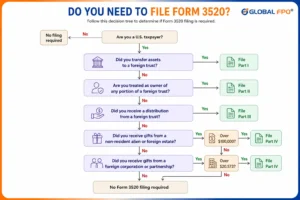
You are required to file Form 3520 if any of the following conditions apply:
- Transactions with a Foreign Trust: U.S. persons who establish, transfer assets to, or receive distributions from a foreign trust must file this form.
- Receipt of Foreign Gifts: If you receive gifts or inheritances from a foreign individual or entity that exceed IRS thresholds (for example, more than $100,000 from a non-resident alien or foreign estate in a tax year), reporting is mandatory.
- Beneficiaries of Foreign Trusts: Individuals who receive distributions as beneficiaries of foreign trusts are also required to file.
Before submitting, it is advisable to review the latest Form 3520 instructions or consult a tax expert to confirm your filing responsibilities.
Also Read: Instructions for Filling Out Form 941 Schedule B
A Step-by-Step Form 3520 Decision Tree (2026)
Why Accurate Filing of Form 3520 Is Important
Completing Form 3520 Instructions correctly is important for several reasons:
- Regulatory Compliance: The IRS relies on this information to oversee international financial transactions and enforce tax laws.
- Avoidance of Penalties: Errors or missing information can result in significant penalties, often calculated as a percentage of the transaction amount.
- Transparency: Proper disclosure ensures a clear and traceable record in case of an audit.
- Financial Planning: Accurate reporting helps in evaluating your overall financial position and planning future tax obligations.
Carefully following Form 3520 instructions, and seeking professional support when needed, can help ensure accuracy and compliance.
Form 3520 Penalty Amounts for 2026: What You Risk
| Form 3520 Part |
What It Covers |
Penalty |
| Part I |
Transfers to a foreign trust |
Greater of $10,000 or 35% of transferred amount |
| Part II |
U.S. owner of foreign trust |
Greater of $10,000 or 5% of owned trust assets |
| Part III |
Distributions from foreign trust |
Greater of $10,000 or 35% of distribution value |
| Part IV |
Foreign gifts/inheritances |
5% per month, capped at 25% of gift amount |
| Continuation (Parts I–III) |
Ongoing non-compliance after IRS notice |
$10,000 per additional 30-day period |
Step-by-Step Instructions for Completing Form 3520
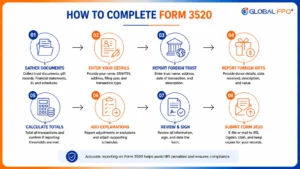
Below is a detailed breakdown of how to complete Form 3520 correctly, step by step.
Step 1: Gather Required Documentation
Before starting, make sure you have all relevant documents ready:
- Foreign Trust Documents: Gather copies of the trust agreement, amendments, and any related correspondence.
- Gift or Bequest Records: Collect proof of foreign gifts or inheritances, including source and amount details.
- Financial Statements: Obtain documents or valuations that establish the value of assets transferred or received.
- Personal Identification: Keep your SSN or ITIN, along with your legal name and address as per IRS records.
- Supporting Schedules: Prepare additional worksheets or schedules that explain transaction details.
Organizing these in advance makes the filing process smoother and more accurate.
Step 2: Begin With the Identification Section
Start by entering your basic details:
- Line 1 – Taxpayer Information: Provide your full legal name along with your SSN or ITIN. Ensure it matches IRS records.
- Line 2 – Address: Enter your current mailing address.
- Line 3 – Filing Year: Indicate the tax year for which you are filing Form 3520.
- Line 4 – Transaction Type: Specify whether you are reporting a foreign trust transaction or a foreign gift.
Step 3: Provide Information About the Foreign Trust (If Applicable)
If your filing involves a foreign trust, complete the following:
Line 5 – Trust Name: Enter the official name of the foreign trust as listed in its documentation.
Line 6 – Trust Identification: Include the trust’s identification number or other identifying details, if available.
Line 7 – Trust Address: Provide the trust’s foreign address.
Line 8 – Date of Transaction: State the date when the transaction occurred.
Line 9 – Description of Transaction: Briefly explain the type of transaction, such as a transfer of assets or a distribution.
Accurate details here help the IRS clearly understand your involvement.
Also Read: What Is Form 2555
Step 4: Report the Receipt of Foreign Gifts (If Applicable)
If you received a foreign gift or inheritance, complete this section:
Line 10 – Donor Information: Enter the donor’s name, address, and identification details.
Line 11 – Date of Receipt: Specify when the gift or inheritance was received.
Line 12 – Description and Value: Provide a description and the fair market value of the gift.
Line 13 – Total Gift Amount: If multiple gifts were received, report the combined total.
This ensures complete and transparent reporting of foreign gifts.
Step 5: Calculate the Total Reportable Amount
Now summarize your totals:
Line 14 – Total Transactions: Combine the values of all reported trust transactions and/or foreign gifts.
Line 15 – Comparison to Thresholds: Confirm whether the total meets or exceeds IRS reporting thresholds based on your filing situation.
Getting these numbers right is essential for compliance.
Step 6: Provide Additional Details and Explanations
Include any necessary supporting information:
Line 16 – Adjustments or Exclusions: Explain any adjustments or exclusions that apply to your reported amounts.
Line 17 – Attach Supplemental Schedules: Indicate that additional documents or schedules are attached to support your reporting.
This section helps clarify complex transactions and supports your figures.
Step 7: Review, Sign, and Date the Form
Before submitting the 3520 form, perform a detailed review:
Review: Check each line carefully to confirm accuracy.
Sign and Date: Sign and date the form as required. Follow IRS guidelines for electronic signatures if applicable.
Include Attachments: Ensure all supporting documents and schedules are properly attached.
A careful review minimizes errors and avoids processing delays.
Step 8: Submit Your Form 3520
Once everything is complete, proceed with filing:
Electronic Filing: If submitting electronically, ensure Form 3520 is included correctly in your return package.
Mailing: If filing by paper, verify where to mail form 3520 using the latest IRS instructions. It is generally sent to the IRS service center in Ogden, Utah.
Keep Copies: Retain copies of the completed form and all attachments for future reference.
Following the correct submission process ensures timely and accurate processing.
Get Expert Help with Form 3520 Filing
Form 3520 reporting can be complex, especially when foreign trusts, gifts, or inheritances are involved. Our tax professionals ensure your filing is accurate, complete, and compliant with IRS requirements, helping you avoid costly mistakes and penalties.
Let Experts Handle Your Form 3520 Filing
Additional Tips and Best Practices
- Organize Your Documentation: Maintain detailed records of foreign transactions throughout the year to simplify filing.
- Double-Check Your Calculations: Verify all figures before entering them on the form.
- Stay Updated: Refer to the latest IRS guidance, as requirements and thresholds may change.
- Seek Professional Help: If your case is complex, professional tax services can help ensure accuracy.
Leveraging Professional Tax Services
Completing IRS form 3520 can be complex, especially if multiple foreign trusts or high-value transactions are involved. Professional tax services can assist by offering:
- Expert interpretation of IRS requirements
- Efficient and accurate filing processes
- Customized support based on your financial situation
- Confidence that your reporting is complete and compliant
Choosing professional support is especially useful for complex international financial scenarios.
File with Precision and Stay Fully Compliant with IRS Requirements
Filing Form 3520 is not something you can afford to treat casually. Every detail you report shapes how the IRS evaluates your international financial activity. When you follow Form 3520 instructions correctly, you are not just avoiding penalties; you are building a clear and defensible record of your foreign transactions.
A well-prepared 3520 form reduces audit risks, improves financial visibility, and keeps your reporting aligned with IRS expectations. If your situation involves multiple trusts, high-value gifts, or incomplete documentation, expert guidance can make a significant difference.
Global FPO supports you through every step of the process, from documentation review to final submission, ensuring your IRS form 3520 is accurate, complete, and compliant.
Schedule Your Free Form 3520 Consultation
Have questions about your Form 3520 filing requirements? Speak with our international tax experts for personalized guidance. We’ll review your situation, explain your reporting obligations, and help you file with confidence.
Book a Free Consultation for Form 3520 Filing
FAQs
Que: 1. Do I need to file Form 3520 if I received money from my parents abroad?
Ans. Yes, if the total amount exceeds $100,000 in a tax year, it must be reported under Form 3520 Instructions, even if it is a personal gift.
Que: 2. What happens if I file Form 3520 late but no tax is due?
Ans. Even without tax liability, late filing of the 3520 form can trigger penalties based on the transaction value, not the tax owed.
Que: 3. Can I file Form 3520 electronically with my tax return?
Ans. In many cases, IRS form 3520 is filed separately and not always through standard e-filing. You should confirm current filing methods before submission.
Que: 4. Where to mail Form 3520 if I am filing from outside the U.S.?
Ans. The mailing location does not change based on your residence. You still need to confirm where to mail form 3520, typically the IRS service center in Ogden, Utah.
Que: 5. Do I need to report a foreign inheritance that is below $100,000?
Ans. No, reporting thresholds apply. If the total foreign inheritance does not exceed the limit, filing Form 3520 may not be required.
Que: 6. Is Form 3520 required if the foreign trust has no activity during the year?
Ans. Yes, if you are considered an owner or have reporting obligations, you may still need to file under Form 3520 Instructions, even without transactions.
Que: 7. How do I determine the fair market value of a foreign gift?
Ans. You must report the fair market value at the time of receipt. This often requires valuation documents or financial statements for accuracy.
Que: 8. What is the difference between Form 3520 and Form 3520-A?
Ans. Form 3520 is filed by the individual taxpayer, while Form 3520-A is typically filed by the foreign trust itself to report annual information.
Que: 9. Can incorrect reporting on Form 3520 trigger an IRS audit?
Ans. Yes, inconsistencies or missing details in the 3520 form can increase the likelihood of IRS scrutiny or an audit.
Que: 10. Do I need professional help to file Form 3520?
Ans. If your case involves multiple trusts, large transactions, or complex structures, professional assistance can help ensure your IRS form 3520 is accurate and compliant.
 +61 (485) 921-100
 +1 (347) 781-5928
 +44 (7700) 170-900
 contact@globalfpo.com